How AI Bots Impact Website Performance and What You Can Do About It
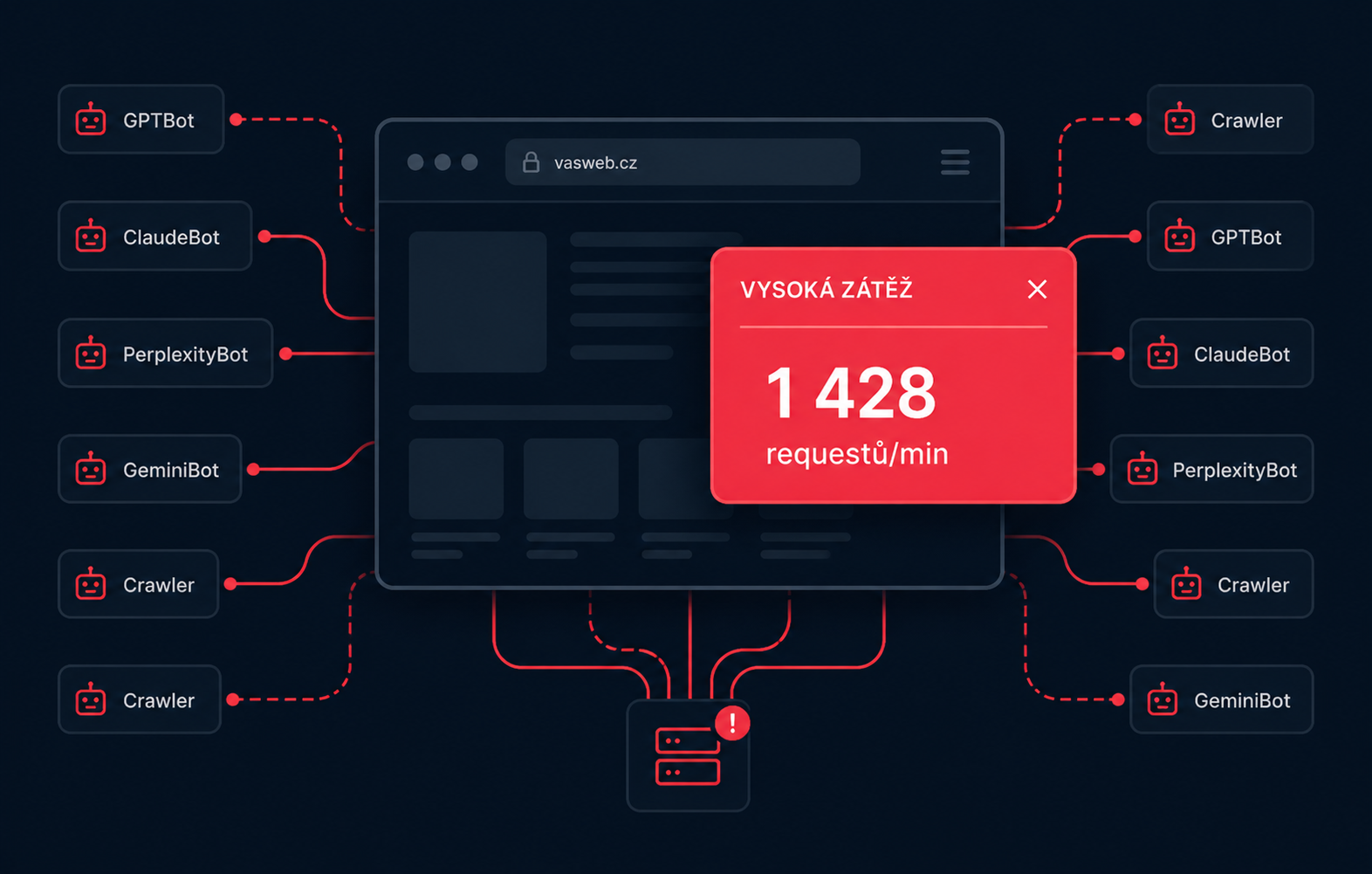
Internet is changing faster than most companies realize. In addition to human visitors, websites are now being heavily accessed by AI crawlers that collect content for ChatGPT, Gemini, Perplexity, and other AI systems. The problem is that these bots often behave very differently from traditional visitors. They generate significantly higher loads, crawl vast numbers of pages, and can slow down even well-built websites.
AI Bots Are Not Traditional Crawlers
Web crawlers have existed for decades. Googlebot and SeznamBot have been a standard part of the internet for years. However, the new generation of AI crawlers often behaves much more aggressively:
-
Crawling large numbers of pages simultaneously
-
Accessing deep sections of a website
-
Placing heavy load on dynamic pages
-
Generating parallel requests
-
Repeatedly fetching the same content
From a server's perspective, their behavior often resembles a load test more than a standard website crawl.
The biggest challenges typically affect:
-
E-commerce websites
-
Large product catalogs
-
Websites with extensive filtering options
-
Dynamic web applications
-
Knowledge base platforms
-
Content-heavy websites with large numbers of URLs
How to Tell If You Might Be Affected
Common warning signs include:
-
High TTFB without a corresponding increase in visitor traffic
-
Unusual traffic spikes during the night
-
Large numbers of requests to low-traffic URLs
-
Increased database load
-
Rising bandwidth consumption
-
Unknown or suspicious user agents
The challenge is that many AI crawlers are not easy to identify. Some disguise their user-agent strings or ignore robots.txt directives altogether.
Why robots.txt Is No Longer Enough
Many companies still assume that robots.txt will solve the problem. In reality, it is more of a recommendation than a security mechanism.
Reputable search engines respect it. Some AI crawlers, however:
-
Ignore the rules
-
Circumvent them
-
Or do not properly identify themselves at all
As a result, protecting modern websites requires a more proactive approach:
-
Web Application Firewalls (WAF)
-
Rate limiting
-
Bot management solutions
-
CDN layers
-
Traffic monitoring
-
Behavioral analysis
Without these measures, companies often have very limited visibility into what is actually happening on their infrastructure.
The Biggest Challenge Is Not Just Performance
AI crawlers are not only a performance issue.
They are changing the economics of the web.
Today, AI systems often read, process, and present content directly to users without sending them to the original website. This creates several challenges:
-
Fewer website visits
-
Higher infrastructure costs
-
Greater pressure on performance
-
A changing SEO landscape
-
Increased importance of brand authority and trust
In many cases, websites are no longer read primarily by humans. They are read by machines that redistribute information elsewhere.
What Makes Sense Today
The worst option is to ignore the problem.
At a minimum, companies should:
-
Monitor traffic and server load
-
Analyze access logs
-
Track unusual crawling patterns
-
Deploy a CDN and caching layer
-
Implement rate limiting
-
Isolate critical parts of applications
-
Perform regular infrastructure audits
In many cases, even a basic combination of:
-
Cloudflare
-
Properly configured caching
-
WAF protection
-
Monitoring
-
Restrictions on aggressive crawling
can significantly reduce server load without negatively impacting SEO or AI visibility.
Blocking AI Bots Completely Is Not Always the Right Answer
A common question today is:
"Should we block AI crawlers entirely?"
There is no universal answer.
Some AI systems:
-
Can drive referral traffic
-
Influence brand visibility in AI-powered search experiences
-
Use your content as a source of information
For that reason, it is often better to:
-
Manage
-
Filter
-
Limit
-
Prioritize
rather than block everything indiscriminately.
The strategy is starting to resemble SEO. It is no longer just about allowing or denying access. It is about control and prioritization.
AI Traffic Will Continue to Grow
This is not a short-term issue.
AI agents and crawlers will account for an increasingly large share of internet traffic. Some estimates already suggest that automated traffic represents a significant percentage of overall web activity.
Companies that:
-
Do not monitor traffic
-
Do not understand where their traffic comes from
-
Lack infrastructure protection
-
Rely solely on basic hosting services
will feel the impact more and more over time.
This is not just about performance. It is about preparing your website for the next evolution of the internet.
Are you experiencing website slowdowns, unexpected traffic spikes, or suspicious traffic patterns? Get in touch with us. We can help you identify infrastructure bottlenecks, implement effective protection measures, and prepare your website for the growing demands of the modern web.