Who Has the Final Say? Assisted, Delegated, and Autonomous AI
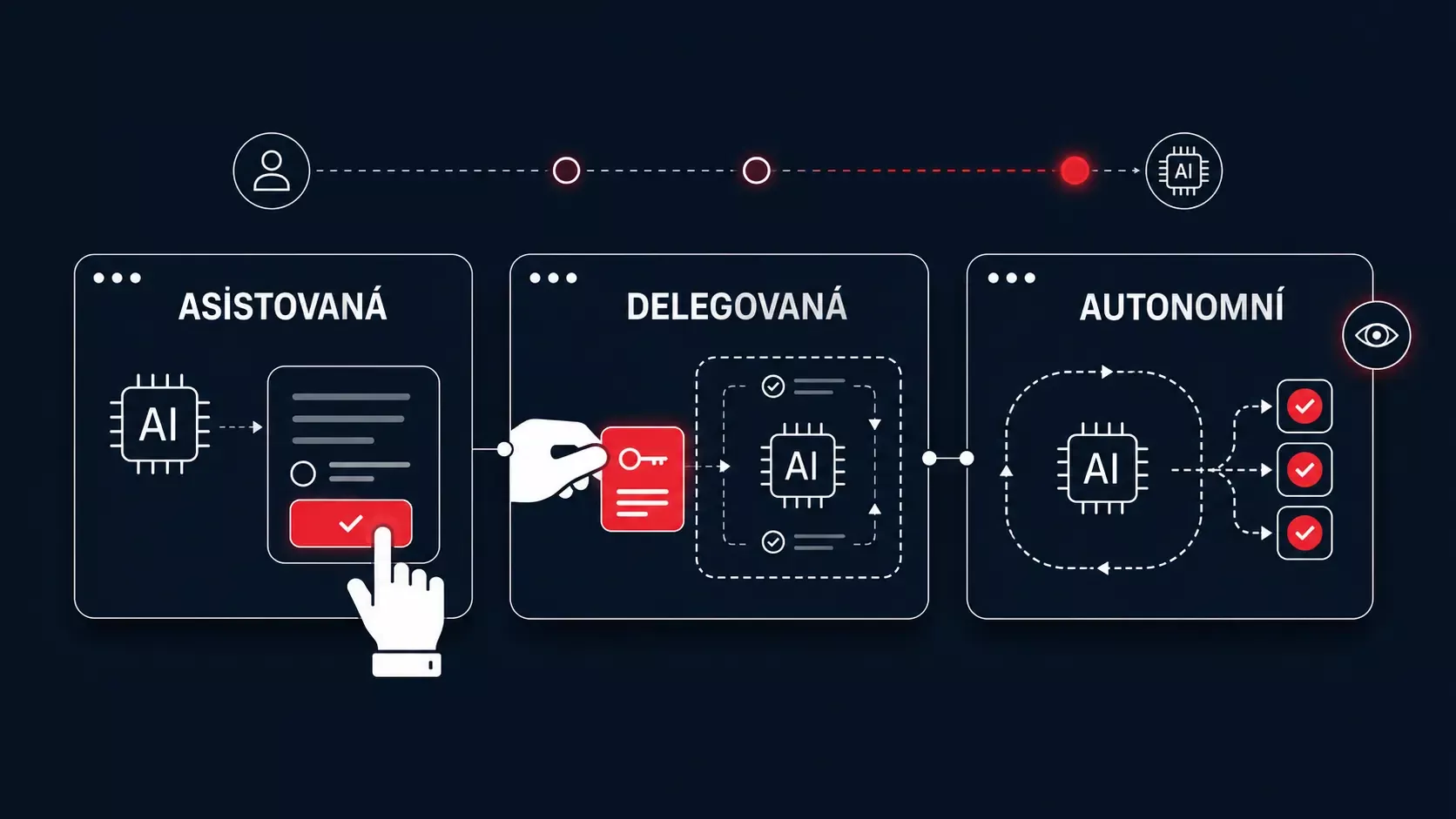
The main difference between assisted, delegated, and autonomous AI lies in who makes the decisions, who carries out the final action, and when a human enters the process.
Assisted AI makes suggestions, while a human reviews and approves them. Delegated AI handles routine cases independently and escalates exceptions to a person. Autonomous AI plans and executes actions on its own, but only within clearly defined boundaries.
This distinction is not simply about how intelligent or powerful the underlying model is. The same language model can be used in both an assisted and an autonomous system. What matters is the level of access it has, the actions it is allowed to perform, and the way human oversight is designed.
Understanding these levels helps companies avoid handing too much control to AI before they can reliably measure its performance, detect errors, and stop unwanted actions.
Three Levels of AI Based on the Human Role
The terms assisted, delegated, and autonomous AI represent a practical framework rather than a universally binding technical classification. In reality, AI systems exist on a spectrum ranging from fully manual processes to systems that operate without day-to-day human involvement.
The NIST AI Risk Management Framework describes human–AI collaboration in a similar way—as a continuum. AI may serve as an additional source of input, escalate a decision to a human expert, or make decisions autonomously. The right setup always depends on the specific use case and the potential impact of an error.
NIST’s profile for generative AI also highlights that different use cases may require different levels of human control, documentation, and operational oversight.
| Mode | What the AI Does | Human Role | Typical Control Method |
|---|---|---|---|
| Assisted AI | Prepares a draft or recommendation | Reviews and approves every output | Human in the loop |
| Delegated AI | Handles standard cases independently | Manages exceptions and monitors operations | Rules and escalation procedures |
| Autonomous AI | Plans and performs actions within a defined environment | Sets goals, boundaries, and oversight | Monitoring, limited permissions, and intervention mechanisms |
1. Assisted AI: The System Advises, the Human Decides
In assisted mode, AI prepares a draft or recommendation, but nothing happens without human approval. A person reviews every output and retains the final decision.
Typical examples include AI that:
-
drafts a response to a customer;
-
summarises a document or business meeting;
-
suggests changes to a contractual clause;
-
recommends a category for an incoming request;
-
creates the first version of an analysis or proposal.
The user can accept, edit, or completely reject the output. In this mode, AI makes work faster, but it does not send emails, modify important records, or make binding decisions on its own.
When Is Assisted AI the Right Choice?
Assisted AI is particularly useful during an initial rollout, when you do not yet understand all possible input types and failure scenarios. It is also suitable for tasks that require interpersonal context, professional judgement, or legal accountability.
Typical examples include contracts, sensitive customer communication, HR decisions, and activities with a significant financial impact.
However, human review must be meaningful rather than merely formal. If people automatically approve everything because they are overwhelmed by the volume of outputs, automation bias can arise—the tendency to trust a system’s results without sufficient critical review.
Effective oversight requires users to understand the limitations of AI, have enough information to assess its output, and be genuinely able to reject it.
2. Delegated AI: The System Works, the Human Handles Exceptions
In delegated mode, a person no longer approves every routine case. The AI can continue independently whenever predefined conditions are met. Unclear, risky, or unusual situations are escalated to a human.
The human acts as an emergency brake while also monitoring the overall quality of the system. They do not manage every routine task, but they must still be able to intervene when the system moves beyond its defined boundaries.
Invoice processing is a useful example. A system can read an incoming invoice, compare it with a purchase order, and prepare it for accounting.
It proceeds automatically only if the supplier, amount, purchase order number, and other required details all match. If it detects a discrepancy, it sends the case to an accountant.
Delegated AI requires:
-
a clearly defined standard case;
-
measurable conditions for a correct result;
-
clear rules for escalating exceptions;
-
limited permissions;
-
an audit trail of completed actions;
-
ongoing monitoring of quality and errors;
-
the ability to correct or reverse an action.
It is not enough to let the model decide for itself that its answer is “good enough.” Whenever possible, quality should be verified using external rules, comparisons with source data, mandatory fields, or another independent control mechanism.
3. Autonomous AI: The System Decides and Acts Within a Defined Environment
Autonomous AI receives a goal and can independently plan individual steps, select tools, work with data, and perform actions without daily human approval.
An autonomous agent might, for example, distribute internal requests, plan technical tasks, monitor the operational state of a system, or perform reversible infrastructure optimisations within predetermined limits.
However, autonomy does not mean unlimited freedom. A reliable autonomous system needs a clearly defined operating environment that specifies:
-
which data and tools it may access;
-
which types of actions it may perform;
-
which financial, time, or operational limits it must not exceed;
-
which actions are prohibited or require approval;
-
how it determines that a task has been completed;
-
when it must stop or ask for help;
-
how its activity can be interrupted and returned to a safe state.
Microsoft’s security guidance for autonomous agent systems points out that as autonomy increases, so does the potential impact of misconfiguration, misuse, or attacks. Permissions and operational boundaries are therefore just as important as the agent’s capabilities.
For critical agent-based systems, Google Cloud recommends maintaining a mechanism that allows people to monitor, interrupt, or modify an agent’s activity. Even highly autonomous operations still require an effective means of human intervention.
Humans do not disappear from an autonomous system. Their role shifts from day-to-day approver to architect, owner, and operational supervisor. They define the rules, monitor results, manage incidents, and decide how the system should change.
Autonomous Does Not Mean Unaccountable
A common misconception is that autonomous AI operates entirely without people. In reality, someone should always remain responsible for the system’s purpose, permissions, monitored metrics, and response to incidents.
For higher-risk applications, human oversight may also be a legal requirement. Article 14 of the European AI Act introduces requirements for effective human oversight of high-risk AI systems.
The level of oversight should reflect the risk, degree of autonomy, and context of use. Depending on the circumstances, the responsible person should be able to interpret, disregard, or reverse an output and safely stop the system.
This does not mean that every business AI tool is automatically classified as high-risk. It does, however, illustrate an important principle: the more serious the potential consequences of an error, the stronger the control mechanisms and human authority to intervene must be.
When Can a System Move From Assisted to Delegated Mode?
The transition should not be based only on the feeling that “it works most of the time now.” Before delegation is introduced, the organisation must be able to define what a correct result looks like and how an error can be recognised.
A system may be ready for delegated operation when:
-
it produces stable results across representative cases;
-
clear metrics and acceptable thresholds have been defined;
-
the team understands the main failure modes;
-
standard outputs can be verified automatically;
-
unclear cases are safely escalated to a person;
-
completed actions can be traced and reversed when necessary;
-
users understand how the system works and when they should not trust it.
Is Testing the System on Twenty Examples Enough?
There is no universal number of tests after which an AI system can be considered safe for delegated operation.
Twenty cases may be a useful starting point for quickly identifying basic issues, but they will rarely be sufficient evidence of production-level reliability.
The size of the test set must reflect the variety of inputs, number of exceptions, and potential impact of an error. It should include common cases, edge cases, historically problematic inputs, and examples that may confuse or mislead the system.
When Can Delegated AI Be Given Greater Autonomy?
Before autonomy is expanded, the system should demonstrate stability in real-world operation, not just in a controlled test. Its exceptions must be understood, and the way they are handled must be sufficiently reliable.
In particular, organisations should verify:
-
consistency of quality over time;
-
behaviour when inputs are incomplete or unexpected;
-
resilience to failures of tools or data sources;
-
correct configuration of access permissions;
-
limits on costs, number of steps, and runtime;
-
working alerts, audit logs, and shutdown mechanisms;
-
clear responsibility for operations and incidents.
Autonomy also does not need to be introduced across an entire process at once. A system might independently collect information and classify requests while still requiring approval before sending a message or carrying out a financial transaction.
Why Is There No Universally Acceptable Error Rate?
An error rate of 5, 10, or 15 percent does not, by itself, indicate whether a system is ready for autonomous operation. The nature and impact of the errors matter far more.
A ten-percent error rate may be acceptable when AI is suggesting internal labels that can easily be corrected. A single incorrect payment, unauthorised disclosure of data, or unfair HR decision may be unacceptable even if the system’s overall accuracy is otherwise very high.
In addition to overall success rates, organisations should therefore monitor:
-
the severity of individual error types;
-
the proportion of false positives and false negatives;
-
the number of cases escalated to a person;
-
the frequency of manual corrections;
-
the ability to detect errors in time;
-
whether completed actions can be reversed;
-
the number and impact of incidents;
-
the cost and time required for operational oversight.
A New Client or Process Creates a New Context
A system that operates autonomously for one client may not be equally reliable for another. The data, terminology, company policies, types of exceptions, user expectations, and acceptable level of risk may all be different.
When a system is introduced into a new context, it is therefore sensible to temporarily reduce its autonomy. Depending on the potential impact of the process, it may return to delegated or even assisted mode.
Only after it has been validated using real cases should it gradually regain a greater degree of independence.
The same principle applies following a significant change to the model, prompt, data source, integration, or business rules. Previous results do not automatically prove that the new configuration will be equally reliable.
How to Choose the Right Level of AI Autonomy
When making the decision, ask five questions:
-
How serious could the consequences of an incorrect result be?
-
Can an error be detected before it causes harm?
-
Can the completed action be reversed easily?
-
Can we objectively define and measure a correct result?
-
Does the system have a safe escalation and shutdown mechanism?
The greater the potential impact of an error, the more difficult it is to detect, and the harder the action is to reverse, the stronger the case for assisted or delegated operation.
The best AI system is not necessarily the most autonomous one. It is the system that uses the lowest level of autonomy required to deliver the desired value while keeping risk under control.
Can One System Combine All Three Modes?
Yes. In practice, this is often the best solution.
AI may autonomously gather the necessary information, classify a case under delegated rules, and then request human approval before making the final decision.
The level of autonomy should therefore be defined for individual decisions and actions rather than assigning a single label to the entire application.
Is a Standard Chatbot Autonomous AI?
Usually not. A chatbot that only answers questions and does not independently carry out actions is closer to assisted AI.
It becomes more autonomous when it can plan its own approach, use tools, modify data, or trigger follow-up processes.
How Can We Tell Which Mode a System Is Actually Using?
Look at who has the final say.
If a person approves every output, the system is operating in assisted mode. If AI handles standard cases and a person only manages exceptions, it is operating in delegated mode. If the system independently plans and performs actions within defined boundaries, it is operating in autonomous mode.
Autonomy Is Not the Goal at Any Cost
A well-designed AI system does not need to do everything by itself. It needs to handle the specific tasks and decisions entrusted to it reliably.
Start with assistance, collect real-world results, and gradually automate only the situations you can measure, control, and safely reverse. Introduce greater autonomy only when the system understands its boundaries and people know when they need to step in.
Not sure how much control you can safely hand over to AI in your processes? Get in touch. Together, we can map the key decision points, risks, and safeguards and design a path from your first AI assistant to automation that genuinely works.