The AI Sandwich: Why Even the Best Model Can’t Save Bad Data
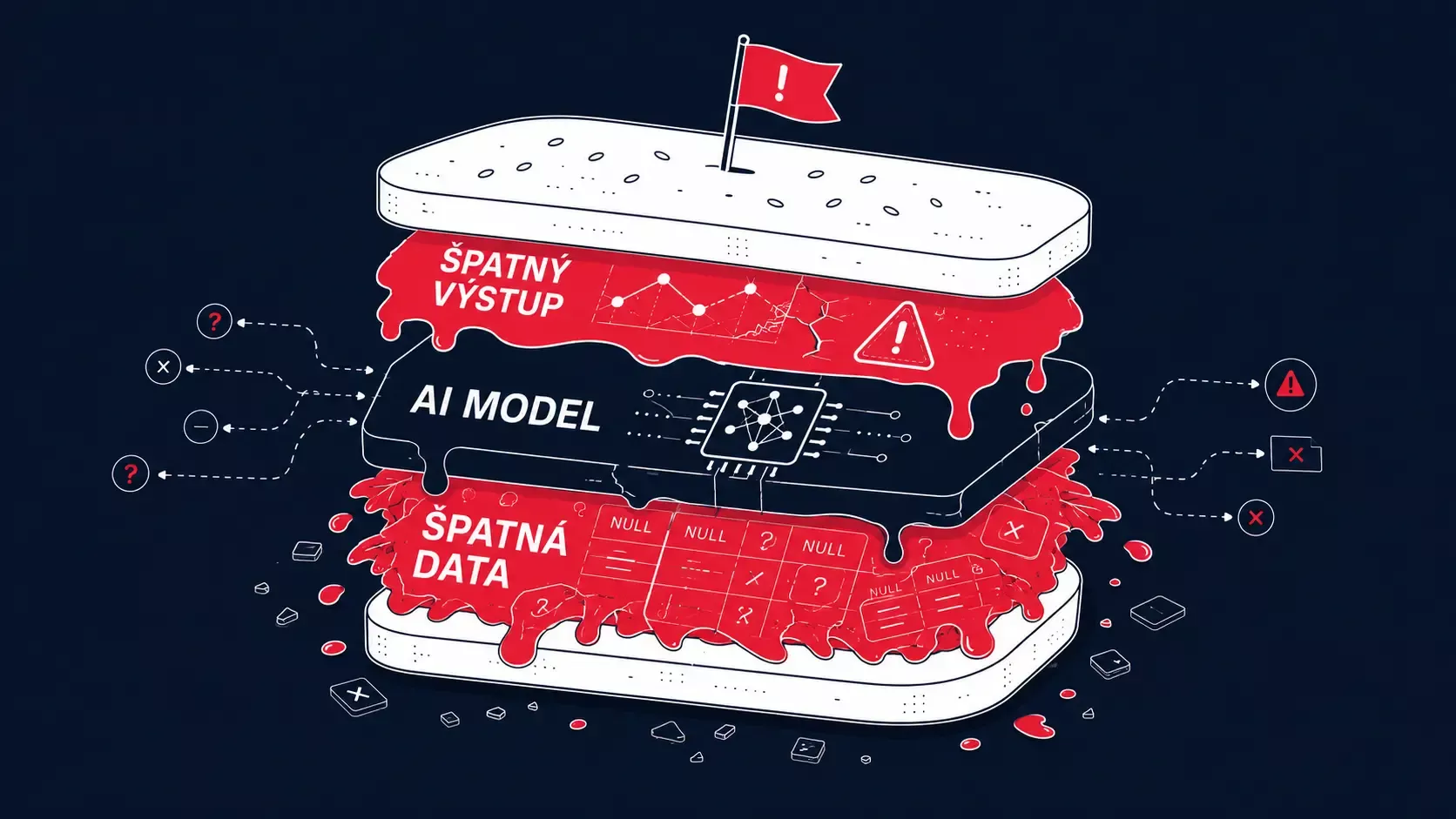
The AI sandwich is a practical metaphor for the architecture of AI automation. The top slice represents input data and context, the filling is the AI model itself, and the bottom slice represents output validation, formatting, and delivery. If the input or output layer does not work properly, neither a better model nor a perfectly refined prompt will save the entire system.
When companies discuss implementing artificial intelligence, their attention usually focuses on the middle layer. Which language model should we choose? How should we write the prompt? Do we need an AI agent? Would a larger model make sense?
However, AI itself is only one part of the solution. The reliability of the system often depends primarily on what enters the model and what happens to its response afterwards.
This is exactly what the concept of the AI sandwich illustrates.
What Is an AI Sandwich?
The AI sandwich is not a formal technology standard. It is a practical way of thinking about an AI system as three connected layers.
| Layer | What it includes | Key question |
|---|---|---|
| Top slice | Input data, sources, and context | Is the AI receiving accurate, current, and relevant information? |
| Filling | Model, prompt, and processing logic | Can the AI perform the assigned task correctly? |
| Bottom slice | Output validation, formatting, and delivery | Is it safe to use the result and pass it on? |
The individual layers cannot be evaluated separately. A high-quality model cannot reliably work with information it does not have.
Likewise, even a correct output creates no value if it is saved in the wrong system, overwrites accurate data, or is sent to a customer without verification.
The Top Slice: Input Data and Context
The top layer determines what the AI will work with. It is not limited to the text a user enters into a chat.
In enterprise automation, inputs may come from CRM and ERP systems, emails, product catalogues, internal documentation, databases, customer portals, or other applications.
To be usable, these inputs must meet several conditions.
Data Must Have a Clearly Defined Source
If the price of a product differs between the CRM, the online store, and an internal document, the AI cannot determine on its own which value is correct.
The system therefore needs a predefined source of truth: the location whose data is considered valid for a particular purpose.
Data ownership is equally important. Someone must be responsible for the accuracy of the data, its updates, and the rules governing its use. Without an owner, even a properly cleaned data source will gradually drift away from reality.
Data Must Be Current and Traceable
For every source, it should be possible to determine when it was last updated, where the information came from, and whether it is still valid.
This is especially important for prices, product terms, contracts, internal policies, and contact details.
In its profile for managing generative AI risks, NIST recommends assessing data quality and integrity and tracking the origin of the information being used. The amount of data is therefore not the only consideration. Its reliability and traceability matter as well.
AI Needs Relevant Context
A language model may understand the general principles of business communication, but it does not know the company’s current stock availability, individual customer terms, or internal rules unless this information is included in the prompt or provided through a connected source.
One way to supply a model with company-specific information is RAG, or retrieval-augmented generation. Before producing an answer, the system retrieves relevant materials and inserts them into the model’s context.
This process is also known as grounding, meaning that the answer is anchored in verifiable sources.
Grounding can reduce the risk of fabricated or outdated answers. However, it cannot fix a poor-quality source. If the system retrieves an outdated price list or incorrect documentation, the model may produce a highly convincing answer based on incorrect information.
The Filling: Model, Prompt, and Processing Logic
The middle section of the AI sandwich is the artificial intelligence itself. It includes the selected model, prompts, configuration, any connected tools, and the logic that determines the individual processing steps.
This layer matters. Different models vary in their capabilities, speed, cost, and context-window size. A well-designed prompt helps define the task, required format, limitations, and the way uncertainty should be handled.
However, a model cannot replace missing business reality.
If it does not know which sources it is allowed to use, lacks current context, or receives conflicting data, a prompt will only hide the problem. Replacing the model with a more powerful version may improve the wording of the answer, but not necessarily its factual accuracy.
It is therefore important to distinguish between two different situations:
Hallucination: The model produces a claim that is not supported by the available sources.
Source error: The model correctly processes information that is itself outdated or incorrect.
High-quality context and grounding help reduce the risk of hallucinations, but they cannot guarantee an error-free result. If the underlying materials are wrong, the model may simply reproduce the error in a convincing way.
The Bottom Slice: Output Validation and Delivery
An AI output does not have to be limited to text displayed to a user. It may involve creating an order, changing a CRM record, classifying a request, sending an email, triggering another automation, or transferring data into an accounting system.
The greater the impact of the next action, the more important the bottom layer of the sandwich becomes.
The output layer should define:
-
the format in which the model must respond;
-
which values are mandatory and how they will be validated;
-
whether the result matches the source that was used;
-
when the system may proceed automatically;
-
when human review is required;
-
where the output will be saved or sent;
-
how an incorrect action can be traced, stopped, or reversed.
For example, it is not enough to ask AI to extract billing details from an email. Before saving them, the system must verify the company identification number format, required fields, possible duplicates, and whether an existing record should actually be overwritten.
OWASP describes insufficient validation of language-model outputs as an “improper output handling” risk. When unverified content is passed into other parts of a system, it may trigger an incorrect action or create a security issue.
A model’s response therefore cannot automatically be treated as a trusted system input.
Why Is Data So Important for AI?
1. Data Determines Which Reality the System Uses
A model does not understand a company in the same way its employees do. It works with information acquired during training and with the context provided within a specific system.
Without access to current company data, it cannot reliably answer questions about products, customers, or internal processes.
2. Poor Input Leads to Poor Output
The principle of “garbage in, garbage out” applies even to the most advanced models. An incomplete record, outdated document, or incorrectly linked customer can lead to a wrong output regardless of the quality of the AI being used.
The model may also present an incorrect result very convincingly. As a result, the error may not be immediately obvious.
3. Poor-Quality Data Destroys User Trust
Employees build trust in a new system based on their first experiences with it. If they repeatedly have to check, correct, or research its answers again, they will begin to bypass the automation.
The solution may work from a technical perspective but remain unused because people do not trust its results. The investment in the model, integration, and employee training will then fail to deliver the expected value.
4. Automation Allows Errors to Scale Quickly
A manual mistake usually affects one specific case. Incorrect information in an automated system can spread across dozens of orders, responses, or customer records within a short period of time.
This is why it is not enough to monitor whether an automation is running. The accuracy and quality of its results must also be tracked.
Example: An AI Sales Assistant Offers a Product That No Longer Exists
Imagine an AI assistant that prepares responses to customer enquiries. The model uses a high-quality prompt, communicates in a professional tone, and correctly retrieves information from internal product documentation.
However, the documentation still contains a product that the company discontinued several months ago.
The AI does not make a processing error. It finds the relevant document, reads its content, and prepares a convincing offer. The automation then sends the email to the customer without review.
Both slices of the sandwich have failed:
-
the input layer did not contain a current and properly managed source of information;
-
the output layer did not verify product availability before sending the offer.
Further prompt refinement would not solve this problem. The correct solution is to designate the current product catalogue as the source of truth, assign responsibility for maintaining it, and verify the availability of offered products before sending a message.
How to Prepare Data for Reliable AI Automation
1. Map All Data Sources
Document where the automation obtains its information, how frequently each source is updated, and who manages it.
Include unofficial materials such as spreadsheets, emails, and documents stored outside the main system.
2. Define Sources of Truth
For each important data point, identify the system whose value takes priority. If several versions of the same information exist, the automation must have a clear rule determining which one to use.
3. Clean and Standardise the Data
Remove duplicates, correct invalid records, and standardise formats. The preparation process should also address missing values, inconsistent naming, and relationships between systems.
4. Restrict Access According to Purpose
AI should not automatically be given access to all company data. Permissions should be configured according to the specific use case and should reflect the sensitivity of personal, commercial, and otherwise protected information.
5. Define Output Rules
Specify the required format, mandatory fields, acceptable values, and the conditions under which the system may use the result.
For high-risk actions, add human approval or another independent validation step.
6. Monitor Quality in Production
Both data and system behaviour change over time. Continuously evaluate accuracy, relevance, the number of manual corrections, reasons for escalations, and cases in which the model failed to use the correct source.
AI Sandwich Design Checklist
Before launching an automation, verify the following:
-
Do we know where every important input comes from?
-
Have we defined a source of truth for key data?
-
Is the information current, complete, and suitable for its intended purpose?
-
Does the model receive enough relevant context?
-
Can we trace the sources used to produce the answer?
-
Does the output have a clearly defined format?
-
Do we verify the result before the next system action?
-
Does the system know when to hand the case over to a person?
-
Can an incorrect action be stopped or reversed?
-
Do we monitor output quality after deployment?
If the answer to several of these questions is “no,” the problem is probably not the model. One of the supporting layers of the solution is missing.
Can High-Quality Data Eliminate All AI Hallucinations?
No. High-quality and relevant context can significantly reduce the risk of unsupported answers, but it cannot eliminate it entirely.
Grounding must therefore be combined with testing, output validation, monitoring, and human review based on the potential impact of an error.
Do We Need to Clean All Company Data Before Launching AI?
No. Start with the data used by the specific process.
For a pilot project, a smaller, well-managed, and trustworthy source is often more useful than access to a large volume of documents whose validity is unclear.
How Can We Tell Whether the Problem Is the Data or the Model?
Check whether the correct information was available in the input, whether the system retrieved the relevant source, and whether that source was current.
If the model faithfully processed incorrect information, changing the model will not solve the problem. If it had the correct context but produced an answer that contradicted it, the issue may lie in the model, the prompt, the retrieval process, or the validation rules.
Good AI Does Not Start With a Prompt
The model itself may be impressive, but real value is created by the entire system built around it. Reliable AI automation requires clean inputs, relevant context, properly configured processing, and controlled outputs.
Before replacing the model or refining the prompt for the tenth time, look at both slices of the sandwich. That is often where you will find the reason why AI works brilliantly in a demonstration but fails in real-world operation.
Would you like to find out whether your processes and data are ready for meaningful AI automation? Get in touch with us. Together, we will review the entire AI sandwich and design a solution that works not only in a demo, but also in everyday use.